
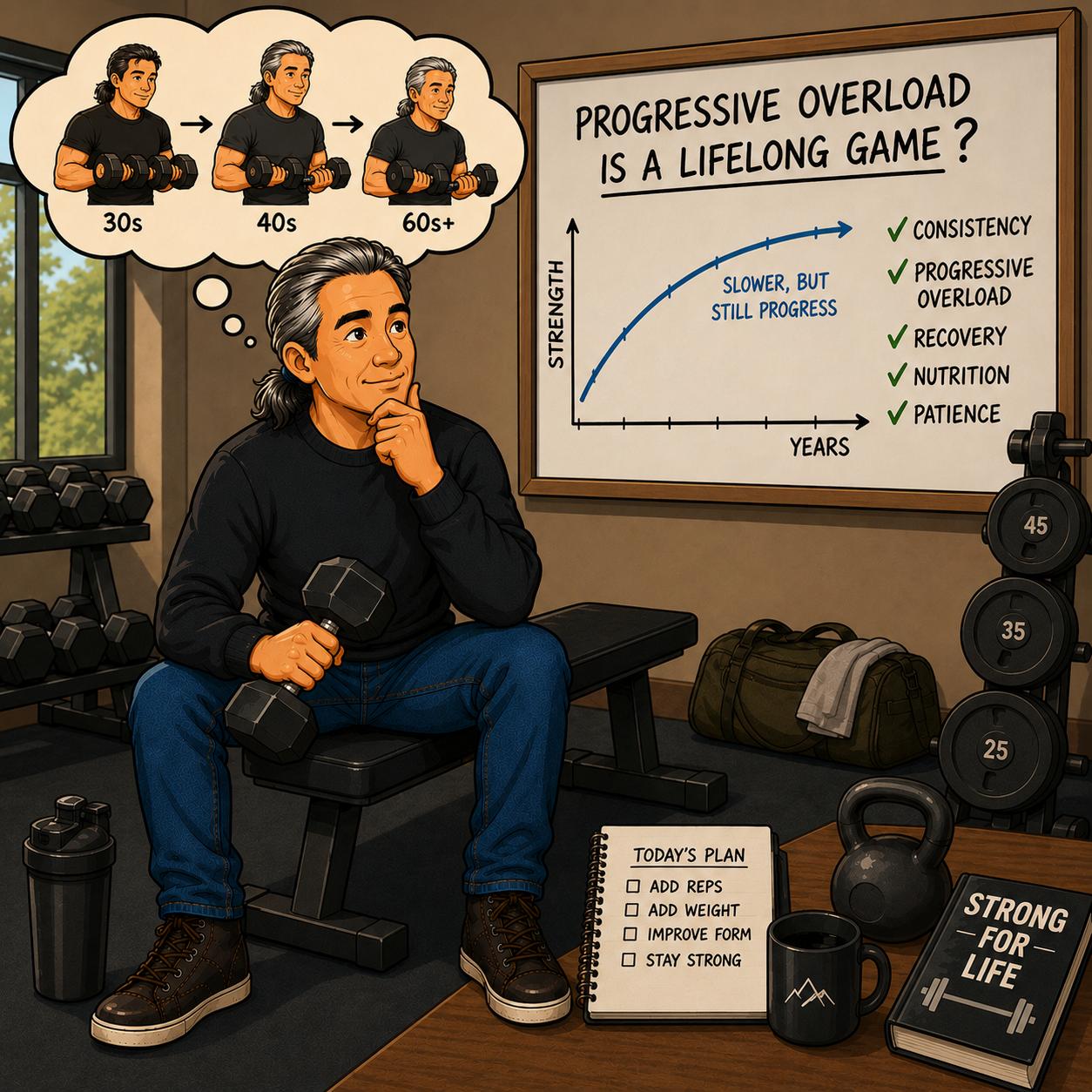
I’ve been strength training for over a decade. My routine centers on dumbbell presses, and for years I’ve worked with two 45 lb. dumbbells for bench press and two 35 lb. dumbbells for overhead press. I do 2 sets of 5 reps and I’ve never gone heavier. At 59, I recently started thinking hard about why that number never moved, and what it means for the years ahead.
The obvious explanation is that I hit an age related ceiling. That explanation is comfortable because it takes the responsibility off me. But when I looked at what I was doing in my workouts, I realized the real issue. I was lifting the exact same weight, for the exact same sets and reps, for years at a time. Repeating a routine without changing it is maintenance.
Listen Here
Does Progressive Overload Really Have No Limit With Age?
Progressive overload is the principle that your body adapts to a training stimulus and then requires a new, greater stimulus to keep improving. Some research suggests this principle still functions in older adults. A study of men in their 70s put fourteen participants through a 12 week progressive resistance program and found real improvements in muscle function. That’s a genuine result, but I’m cautious about stretching a 12 week study on fourteen men into a claim that the mechanism works indefinitely as people age into their 70s, 80s, and beyond.
Muscle repair after a hard training session depends heavily on satellite cells, the specialized cells responsible for repairing and building muscle fibers. Research shows that the number and responsiveness of these cells decline with age, and their response to a single workout can be slower or blunted compared to a younger person’s response. Some studies on resistance training in elderly men and women found measurable increases in satellite cell activity after 12 weeks of consistent training, which researchers point to as evidence the machinery still works. I’d call that evidence the machinery still works at a reduced level for a while. A 12 week improvement in a research setting doesn’t tell me what happens after ten or twenty years of a declining baseline, and I haven’t seen research that follows people that long.
There’s another problem with these studies. Most of them exclude anyone who has trained in the past six months. The same research group behind the 12 week satellite cell study only allowed men in if they hadn’t done any structured resistance or aerobic training recently, and that pattern shows up across this entire body of research. A separate study comparing young and older men described its subjects the same way, as previously untrained.
That changes what these studies measure. A sedentary 74 year old starting a program for the first time is going to see strength and muscle gains almost no matter what, because the body responds strongly to any new stimulus after a long period with none. I’ve trained consistently for over 10 years and I’m trying to push past a baseline my body adapted to years ago. The gains researchers report in these studies may say more about how untrained muscle responds to any training at all than about whether someone in my situation can keep progressing.
What About Lifters Who Were Already Trained?
I went looking for research on people who already had a training history, since that’s a much closer match to my situation than a newly recruited 74 year old. Untrained studies answer a narrow question about how muscle responds to a first exposure to training. Competitive powerlifting gives researchers a large, naturally occurring data set for this problem, because lifters compete year after year and their totals get recorded at every meet. That structure lets researchers track the same people over long stretches of their training careers instead of running a short lab study on strangers.
One study analyzed competition results from powerlifters tracked over time and modeled how their squat, bench press, and deadlift totals changed with age and years of participation. The biggest gains happened early in a lifter’s career, in the range of 7.5 to 12.5 percent in the first year alone, which fits the pattern of most improvement coming from a lower training age rather than from being young in years. But the data on older, long tenured lifters is the part that matters most for my question. Female lifters older than 59 were still gaining strength, in the range of 2.5 to 5 percent, and male lifters older than 69 showed only a slight decline of about 0.35 percent per year. That’s a different picture from the general population, where untrained strength loss runs closer to 1 percent a year.
This is a better answer to my original question than the untrained studies gave me, because it looks at people who kept training year after year rather than people getting their first exposure to a program. It suggests that continued, if slower, progress is possible well into a lifter’s 60s, and that even in the 70s the decline for people who kept training is modest rather than steep. This is observational data from competition records, and it can’t fully separate genetics, injury history, or who stopped competing and dropped out of the data set. Lifters who kept competing into their 70s are also probably a self selected group of people whose bodies held up well enough to keep training hard, which likely flatters the numbers somewhat. Still, this comes closer than anything else I’ve found to answering whether someone with my kind of training history can expect continued progress, and the answer looks like a cautious yes, at a slower pace than in my 30s or 40s.
Where I Plateaued
Given that the underlying biology still supports adaptation, my plateau of over 10 years makes more sense as a training problem than an age problem. Staying at the same weight for the same reps removes the new stimulus that triggers further adaptation. Volume, tempo, and rest periods all offer ways to keep creating that stimulus without needing a heavier dumbbell, which matters for me since my home setup tops out before the next increment I’d need. Research on older adults supports increasing session volume, meaning more sets, as an effective way to keep building strength over time even without adding load.
Diminishing returns are real too. The rate of strength gain slows from your 30s onward, and a 70 year old training as hard as they can will not out lift a 30 year old training just as hard. Where I get skeptical is the claim that this slowdown is purely a training problem and that the ceiling itself barely matters if you just apply enough volume or variety. Declining hormone levels, fewer and less responsive satellite cells, and tendons that synthesize collagen more slowly are physical changes. I don’t think a smarter program erases that.
So my plateau is probably a mix of both things. Over 10 years at the same weight and reps is a training problem, and I expect I have room to grow that I haven’t touched. The competition data on trained older lifters backs that up better than the untrained studies did, since it points to a slow but real decline rather than a hard wall, at least for people who kept training consistently. But I’m not willing to assume the room is unlimited. A ceiling that’s higher than my current numbers and declining slowly is not the same thing as no ceiling at all, and until I’ve pushed past this plateau for a while, I’d rather stay skeptical than assume the science guarantees me a way around age entirely.
The Shoulder Complicates Things Right Now
None of this matters much right now, since I’m dealing with a minor shoulder injury. Tendons age differently than muscle does. Aging tendons show reduced collagen synthesis and a diminished capacity to remodel after injury compared to younger tendons, and the tendon environment becomes less vascular and less cellular over time, which slows the whole repair process down. That matches what I’ve read elsewhere about recovery windows stretching out as people get older, and it lines up with my own experience of minor injuries taking noticeably longer to resolve than they used to.
I’ve dropped to a much lighter weight and I’m staying in a pain free range of motion rather than pushing through discomfort. A physical therapist would be the ideal resource here, but the cost isn’t something I can justify for a shoulder strain that seems to be improving on its own. Instead I’m tracking my symptoms week to week, watching for whether the discomfort is trending down, staying flat, or getting worse, and I’m treating any of the last two as a signal to actually see someone.
Where This Leaves Me
My plateau and the research both leave the ceiling uncertain. I’m treating this as an open question I can only answer by actually changing my training and watching what happens. Once my shoulder is fully healed, I plan to rebuild with more intention, using volume and tempo changes rather than just chasing a heavier dumbbell I don’t have anyway.
Age is a factor in all of this. It slows recovery, it likely lowers the ceiling compared to my 30s by some amount I can’t precisely measure, and it means I have to be more careful with an injury than I once was. I’ll keep training and pushing where I reasonably can, but I’m not going to assume the studies apply the same way to me at 59, or that they’ll still apply the same way at 69, just because the underlying cells are technically still active.
References
- Snijders T, et al. “Prolonged exercise training improves the acute type II muscle fibre satellite cell response in healthy older men.” J Physiol. 2019. https://pmc.ncbi.nlm.nih.gov/articles/PMC6312443/
- “The Resistance Training Effects on Skeletal Muscle Stem Cells in Older Adult: A Systematic Review and Meta-Analysis.” https://pmc.ncbi.nlm.nih.gov/articles/PMC10542207/
- Roth SM, et al. “Enhanced satellite cell proliferation with resistance training in elderly men and women.” https://pubmed.ncbi.nlm.nih.gov/17305939/
- “The Importance of Resistance Exercise Training to Combat Neuromuscular Aging.” American Physiological Society. https://journals.physiology.org/doi/full/10.1152/physiol.00044.2018
- “Impact of Aging on Tendon Homeostasis, Tendinopathy Development, and Impaired Healing.” https://pmc.ncbi.nlm.nih.gov/articles/PMC9851966/
- “Tendon collagen synthesis declines with immobilization in elderly humans: no effect of anti-inflammatory medication.” J Appl Physiol. https://journals.physiology.org/doi/full/10.1152/japplphysiol.00809.2015
- Latella C, van den Hoek D, Wolf M, et al. “Using Powerlifting Athletes to Determine Strength Adaptations Across Ages in Males and Females: A Longitudinal Growth Modelling Approach.” Sports Medicine. 2024. https://link.springer.com/article/10.1007/s40279-023-01962-6
Leave a Reply