
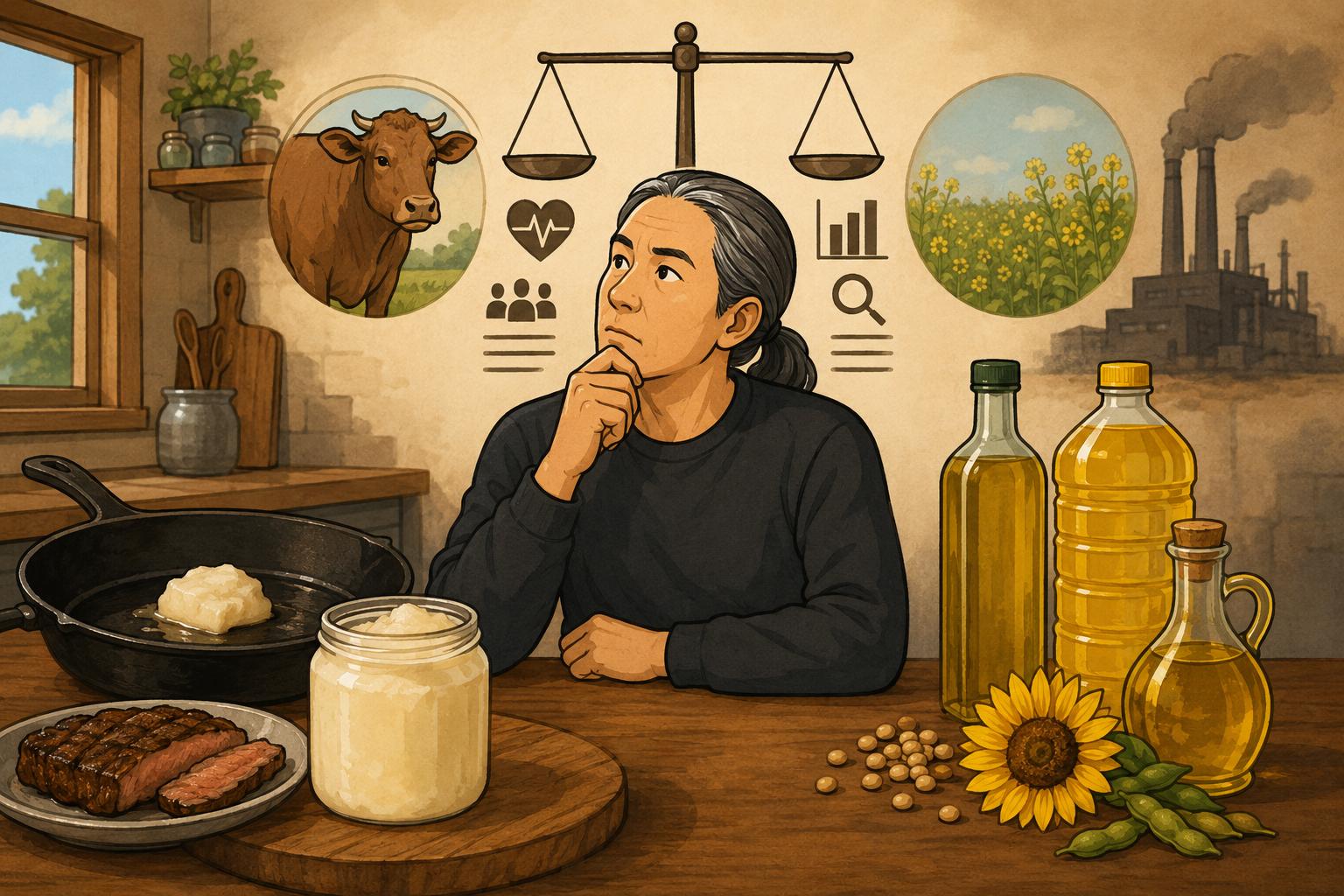
Beef tallow has made a comeback in home kitchens and on social media, often framed as a return to a more traditional fat after decades of seed oil dominance. Cardiologists and public health groups have pushed back, pointing to cholesterol data as the reason to stay away from it. Both sides cite research, and both sides skip over parts of that research that don’t help their story. This post walks through the evidence on each side of the beef tallow versus seed oil debate, along with the critiques of that evidence. You can make the decision for yourself as to what and who to believe.
In early 2026, a group of cardiologists published a review in JACC: Advances titled “A Clinician’s Guide for Trending Cardiovascular Nutritional Controversies in 2026.” The review sorted several controversial foods into three buckets: evidence of harm, evidence of benefit, and foods where the evidence remains unclear. Beef tallow landed in the harm category, alongside ultraprocessed foods and artificial sweeteners. Seed oils and seafood landed in the benefit category.
The review’s case against beef tallow rests on its effect on LDL cholesterol. One of the trials it draws on gave 12 healthy men a 100-gram serving of beef tallow and measured their blood lipids over the following hours. LDL cholesterol rose about 9.3 percent above fasting levels, while the same measurement stayed flat after a comparable serving of corn oil. Other feeding trials cited in the review point the same direction, showing that swapping seed oils for beef tallow tends to raise LDL.
Evidence to date also suggests minimizing or eliminating the use of beef tallow. — JACC: Advances, “A Clinician’s Guide for Trending Cardiovascular Nutritional Controversies in 2026”
The review treats LDL rise as sufficient grounds for its recommendation. But how strong is the underlying link between LDL and cardiovascular risk? That is where the two sides of the debate diverge. The mainstream case for that link and the case against it both draw on decades of research, and both merit a close look before drawing a conclusion.
The mainstream position on LDL rests on two independent lines of evidence. The first comes from Mendelian randomization studies, which use naturally occurring genetic variants that raise or lower LDL from birth. People who carry gene variants for lifelong lower LDL show lower rates of coronary heart disease.
LDL-C is causally associated with the risk of CHD. — Mendelian randomization review, published in Current Opinion in Cardiology
The second line of evidence comes from drug trials. Statins, ezetimibe, and PCSK9 inhibitors all lower LDL through different mechanisms, yet trials of all three classes show reduced cardiac events that scale with how much LDL drops. A 1 mmol/L reduction in LDL from statin therapy corresponds to roughly a 20 percent drop in coronary heart disease and stroke risk. The fact that genetic variation, drug mechanism, and clinical outcome all move together is what drives the LDL hypothesis. This convergence across different study designs is generally considered the strongest form of causal evidence available outside a dedicated outcome trial.
Researcher Uffe Ravnskov and colleagues have published a series of papers arguing that in adults over 60, the relationship between LDL and mortality flips. Their work challenges the assumption that lower LDL predicts better outcomes across every age group. Their 2016 systematic review pooled 19 cohort studies covering more than 68,000 elderly people and found that high LDL predicted lower all-cause mortality in the large majority of the cohorts studied.
High LDL-C is inversely associated with mortality in most people over 60 years. — Ravnskov et al., systematic review published in BMJ Open
Later work extended this finding to specific populations, including cohorts in China and Italy and a long-lived population in Sardinia, all showing the same inverse or U-shaped pattern between LDL and mortality in older age groups. Ravnskov and his co-authors argue reverse causation does not explain this pattern, since some of the included studies excluded people with terminal illness or who died within the first year of follow-up. If sick people have lower cholesterol because they are sick, they reason, removing the sickest participants should have erased the pattern, and it did not.
Nearly all of the strongest causal evidence for LDL, the Mendelian randomization studies and the statin and PCSK9 inhibitor trials, examines LDL as a general biomarker. None of it tested beef tallow as a food. The chain of reasoning runs from beef tallow to a short-term rise in LDL, then from LDL in general to cardiovascular outcomes in trials of genetic variation or drug therapy.
No long-term randomized trial has fed people beef tallow for years and tracked their cardiac events against a comparator diet. The JACC review’s recommendation to limit beef tallow follows logically if you accept that LDL is a reliable stand-in for any LDL-raising exposure. It becomes a weaker inference if you think the LDL-raising mechanism, the food matrix, or the other nutrients that come packaged with a given fat source might matter independently of the cholesterol number alone. Nobody has run the trial that would settle which reading is correct.
I don’t think any of this settles whether beef tallow belongs in a health-conscious kitchen. The evidence that LDL causally drives coronary heart disease in the general population draws on decades of genetic and drug-trial research. The evidence that this relationship inverts in older adults draws on multiple cohorts across several countries and a specific test for reverse causation. No trial has tested beef tallow directly against long-term outcomes. The existing evidence covers only a biomarker whose meaning is debatable.
Anyone weighing beef tallow against seed oils has to decide how much credence to give a short-term cholesterol response, how much weight the age-related pattern in the elderly-mortality data deserves, and how comfortable they are eating a food that has only been evaluated indirectly. The one opinion I have on this matter is that beef tallow is something humans have consumed for centuries, while seed oils are a relatively recent addition to the diet. That doesn’t mean one is better than the other, or that you should fear either. The choice is up to you.
Leave a Reply