
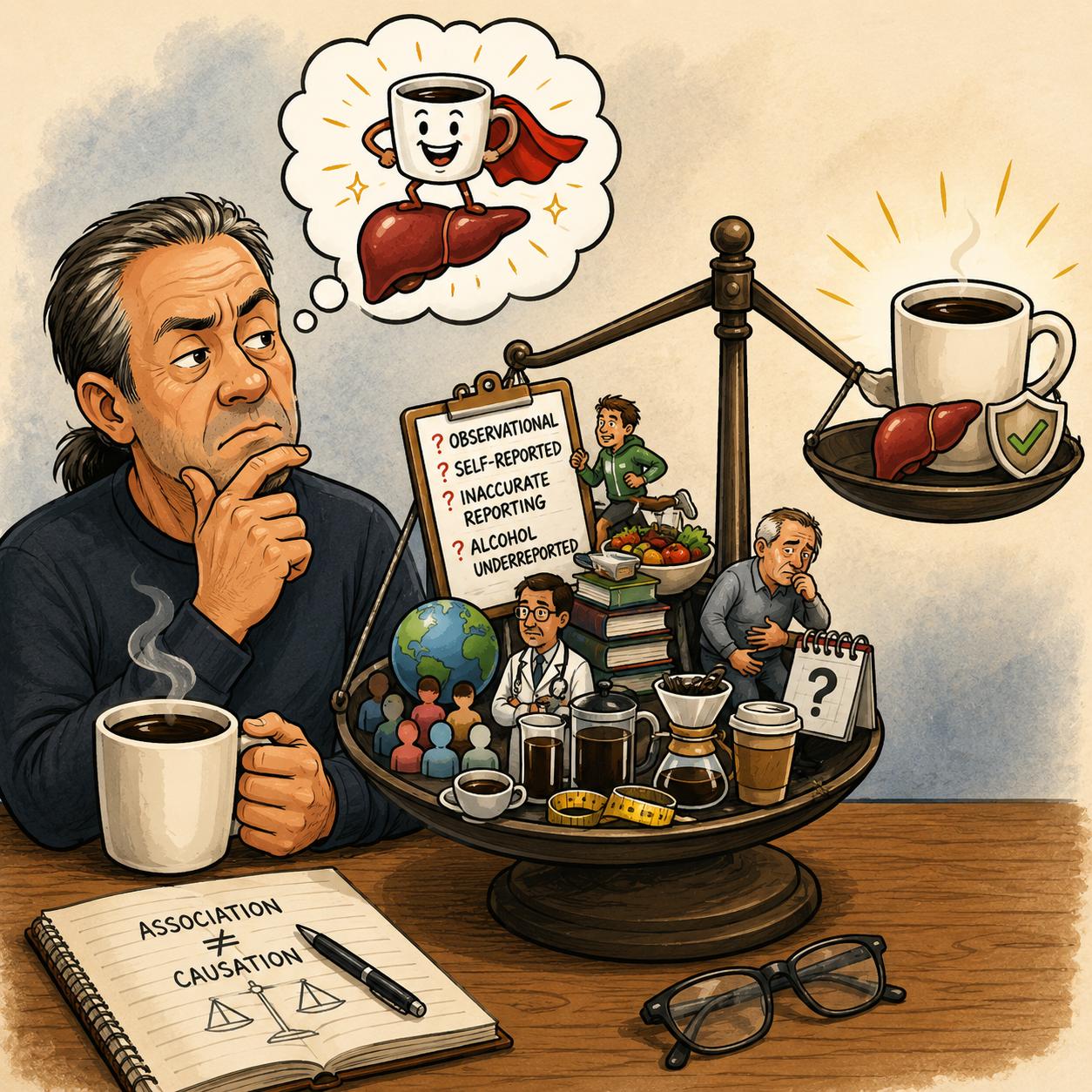
Every few weeks another headline tells us that coffee is either saving our lives or slowly killing us. This week’s claims that coffee reduces the risk of cirrhosis, liver cancer, and death from liver disease. The study was big and followed hundreds of thousands of people for more than a decade. Researchers even ran MRI scans and blood analyses on part of the group. The headlines make it sound like they found compelling evidence that your morning cup of coffee belongs in the medicine cabinet.
Coffee drinking was associated with lower risks of serious liver disease and related mortality, with the more one consumes the better, data from the U.K. Biobank suggested.
Over a median 13-year follow-up, drinking five or more cups of coffee per day was tied to reduced risks of cirrhosis (HR 0.68, 95% CI 0.58-0.79), hepatocellular carcinoma (HR 0.53, 95% CI 0.34-0.83), and liver-related mortality (HR 0.58, 95% CI 0.45-0.74), reported Hyun-Seok Kim, MD, MPH, PhD, of Cedars-Sinai Medical Center in Los Angeles, and colleagues.
Even lower consumption (≥1-2 cups per day) was linked to significantly reduced risks of cirrhosis (HR 0.80, 95% CI 0.72-0.89), hepatocellular carcinoma (HR 0.76, 95% CI 0.57-0.99), and liver-related mortality (HR 0.69, 95% CI 0.58-0.82) compared with no consumption, they noted in Clinical Gastroenterology and Hepatology.
Those associations persisted for both caffeinated and decaffeinated coffee, suggesting that non-caffeine compounds mediate liver benefits, and for unsweetened and sweetened coffee, though estimates were slightly attenuated among those who added sugar or artificial sweeteners.
Medpage Today
I love coffee. I’m drinking a cup right now. I would love for these things to be true. But studies like these have huge limitations, and we need to look at them with a skeptical eye instead of repeating that coffee is a superfood and caffeine is a wonder drug. This coverage gives the impression that coffee protects the liver. What it shows is that people who drank more coffee tended to have healthier livers over time. That’s it. It’s just a correlation.
This was an observational study. Participants self-reported their coffee consumption, and self-reported dietary data are unreliable. Someone who reported drinking four cups a day when they enrolled may have cut back to one cup years later, or stopped drinking coffee altogether, and the study can’t fully account for those changes. People routinely under report how much alcohol they drink, and since alcohol is one of the leading causes of liver disease, even modest inaccuracies in reporting could influence the results. All this study can do is demonstrate an association. It cannot establish that coffee caused the lower rates of liver disease.
There is also the healthy user bias to consider. There is no way to know if coffee drinkers exercise more, eat healthier diets, visit their doctors more often, or have better access to healthcare than non-coffee drinkers. Participants came from the UK Biobank, a large research database whose volunteers tend to be healthier, wealthier, better educated, and more health-conscious than the average person. Results observed in that population may not apply to people in other countries, different ethnic groups, or those with lower incomes or advanced liver disease.
Even the word “cup” is misleading. Was it an eight-ounce cup brewed at home? A sixteen-ounce coffee shop drink? Espresso? French press? Filtered drip coffee? Cold brew? The cup I’m drinking right now is about 12 ounces, made from a single Nespresso lungo capsule that’s designed to produce about four ounces. I just keep pressing the button until the cup is full, so I’m about as far from a coffee snob as you’ll find. Different brewing methods produce different concentrations of caffeine and other compounds that may influence health, yet researchers lump all of these differences together under the single label of “coffee.”
There is also the possibility of reverse causation. People with early liver disease, digestive problems, or other chronic illnesses may stop drinking coffee because it aggravates their symptoms or because a doctor advised them to change their diet. If unhealthy people cut back on coffee, it can create the illusion that avoiding coffee leads to disease when the disease came first. The study’s MRI scans and blood protein analyses added value, but researchers ran those tests on much smaller subsets of participants than the overall study covered. That turns one of the study’s strengths into one of its weaknesses.
No matter what you hear about this study, it cannot prove that coffee prevents liver disease or liver cancer. So what are we supposed to believe? You may believe that evidence supporting coffee continues to grow. Believe that coffee is unlikely to be the health villain it was once portrayed to be. And maybe that there are plausible mechanisms that could explain why coffee might benefit the liver.
If you already enjoy coffee, this study offers another reason to feel good about your habit. If you hate coffee, there is no compelling evidence that you should force yourself to start drinking it to protect your liver.
Leave a Reply